
Post 13: Professional Patient
Nobody wants to live like this.
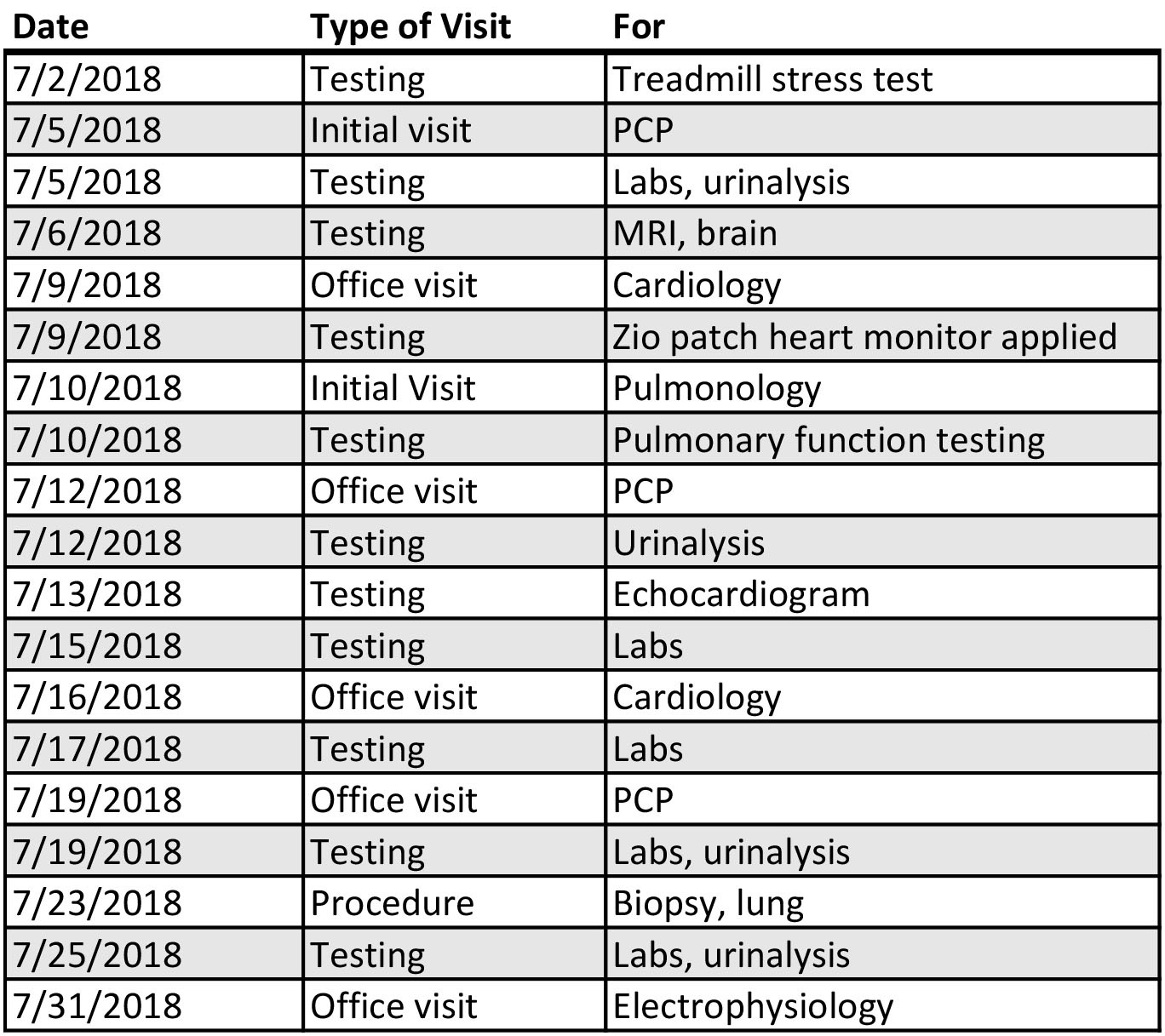
The image shows an Excel spreadsheet grid listing appointments and different tests for July, 2018.
Some Housekeeping
Substack promoters recommend publishing on the same day every week. Publishing on most Fridays was too much, so I’ll try publishing on the same days every month instead, on the 9th, 19th and 29th.
There’s a glossary at the end of this post.
On With The Story
My first time writing in a while, and I’ve been avoidant all morning.
A waist-high pile of folders and papers teeters on the floor. The clutter juts into my peripheral vision, distracting me. The apartment feels unkempt. Gotta sweep and mop!
Although disorganization offends my attention deficit, I’m mostly avoidant because I’m writing about experiences that are difficult to relive, even 8 years later. In July of 2018, my suspected diagnosis was sarcoidosis. I’d have to wait 6–7 weeks until my pulmonology appointment, then longer still for the confirmatory lung biopsy.
Meanwhile, my health felt like an untethered wrecking ball careening down a winding road, smashing something to pieces at every turn (Post 6). I started taking public transportation in lieu of driving, for fear I would pass out. Although I’d taken time off from the lab, I was allowed to return because random falling and syncope are scary and I didn’t want to be alone. And the lab was on the same campus as most of my appointments, where I was begging for help into the void.
I asked my then PCP, Dr. O, if I could be admitted to the hospital.
“Nobody’s going to admit you. We already know you have sarcoidosis,” Dr. O rolled her eyes.
Technically, we didn’t know yet. I asked if I should get a MedicAlert button.
“Only old people need those!” she guffawed.
At 46, I wasn’t old enough to be old. I was terrified to be alone and desperate for answers. And somehow, this was funny …
I’ve heard said, “You think you’re being gaslit now? Just wait until you’re older!” Symptoms in older folks can be flippantly ascribed to “old age.” But I was “too young” to have anything serious. Medical gaslighting is an equal-opportunity affliction across all developmental milestones.
Having little to lose, I called a hospital affiliated with a respiratory clinic and explained my symptoms and test results (Post 7). Was that enough to be admitted and diagnosed?
Yes, they confirmed. Finally!
But I was so traumatized from my previous emergency room visit (Post 4) that I couldn’t muster the gumption to visit another. In retrospect, doing so would’ve expedited my diagnostic odyssey. At the time, making coherent decisions was difficult. As Yogi Berra once said, “When you come to a fork in the road, take it!”
It’s impossible to describe the existential confusion and loss of identity I experienced from the sudden barrage of healthcare visits my illness had triggered. That month, I had clinician appointments (PCP x 3, cardiology x 2, pulmonology and electrophysiology) and tests galore (treadmill, brain MRI, pulmonary function, EKG, biopsy, 2-week heart monitor, echocardiogram, 5 blood draws for labs and 3 urinalyses). My identity had morphed; I was now a professional patient.
Professional Patient
I would soon learn any pain or dysfunction could signify sarcoidosis or “worse,” necessitating timely evaluation. Yearly (or 6-monthly at times) surveillance testing became the norm. PCP visits begat referrals to specialists that begat so many more appointments, testing and referrals that their summation rivals the biblical lineage in the Book of 1 Chronicles.
In the ~8 years since my knees swelled, I’ve had > 650 healthcare-related visits, phone calls with clinicians, telehealth and testing (doesn’t include other insurance/disability/healthcare-related calls or portal messages). This includes 5 surgeries. Some months, I’ve had 20 appointments, with half of those being out-of-state. More than a dozen visits/tests were > 1000 miles (1609 km) away. I’ve seen 35 different specialties and endured hundreds of tests. And every 3 months, I see my indefatigable current PCP, Dr. L.
I’ve had 5 different infections in the past 12 months and in 2026, I’ve had 26 healthcare visits and tests so far. I even canceled a few appointments in January because of a (literally) gut-wrenching, 2-monthlong C. difficile infection. June–August, I’ll have 13 office visits, including my PCP (who will order my yearly EKG and labs), a new geneticist (genetics labs), PT, vision therapy, pain doctor and 2 infusions. I’m not trying to whine or garner pity. I’m just being honest. This is the life of a professional patient (a.k.a., frequent flyer).
I’ve been told, “Must be great to be on disability and not have to work.” Let me be clear: Nobody wants to live like this. I wish I were still running around in the mountains and grading boring nursing papers on weekends. Instead, chronic illness is my job, and it’s enough. Sometimes, it’s too much.
Sometimes Less is More
To reduce the stress of ongoing medical care, Dr. L and I came to an agreement ~4 years ago. I stopped seeing cardiology, pulmonology, neurology and electrophysiology at the respiratory clinic. I didn’t get a new neurologist when my empathetic (if forgetful) neurology PA moved away. Dr. L orders my yearly surveillance testing and refers me to specialists if symptoms worsen or new issues appear. Which happens constantly. Whenever I think I have a handle on my health, something new is always breaking.
To be clear – I’m not suggesting other people should skip vital healthcare! Appropriate and timely healthcare is important and can save your life. But at some point, constant appointments and travel have made me objectively sicker. Sometimes, less is more. I’m fortunate to have a PCP who listens and collaborates. I wish everyone could see her.
I’m Grateful
Sometimes friends seem reticent to talk to me about their health issues. Maybe they think it would upset me, since I deal with a lot. But that’s not how I see it. Illness is not a competition. Everybody has health issues in time that affect their ability to thrive, and I want to be present for that. I don’t just complain about being a professional patient to friends and family; I’ve built an entire Substack around it! The least I can do is afford others the same grace and an empathetic ear.
If you’ve gone through/are going through this, too, I feel for you.
I’m lucky, privileged and grateful it took months, instead of years, to be diagnosed with sarcoidosis. And I’m grateful for the healthcare workers who have helped me. And for friends and family who have lifted me up during my darkest hours. I’m especially grateful for you, dear readers. You’ve given me a purpose as you support and sustain me. If my story can help even one person avoid something awful, all this trouble will have been worth it.
Can you remember the time when you realized you were a professional patient? Or, were you always aware of it? Leave a comment below.
Glossary
EKG – Electrocardiogram. A tracing of the electrical activity of the heart.
PA – Physician’s Assistant.
PCP – Primary Care Provider/Physician. Can be a Medical Doctor, Doctor of Osteopathy, Nurse Practitioner or Physician’s Assistant who coordinates care by ordering tests/referrals, and diagnosing/treating patients.
PT – Physical therapy, which addresses patients’ mobility problems or pain.
Syncope – Fainting.
“Professional patient” is such a painful phrase because it sounds almost like competence, when much of what it names is transferred burden.
A person does not become professional because they wanted expertise as an identity. They become professional because the system has quietly handed them pieces of its own continuity to carry, the archive, the medication history, the translation from one specialist to the next, the judgment call about which new thing is urgent enough to chase. All of it ends up living inside the person who is already spending energy just to stay upright.
That is what makes the workload so hard to see from outside. It looks like “having appointments” or “managing your health.” In practice it is a second job built out of waiting, paperwork, travel, and the constant need to become credible again in front of the next clinician.
Your line, that chronic illness is your job, and sometimes too much, reads as painfully exact. The cruelty in it is that the patient is asked to be the system’s continuous memory while being the very person most depleted by everything that has to be remembered.
Like so many, my professional patient status began during the very early start of Covid in February 2020. It is really helpful to listen to this post! You say so many things out loud and put a name and a description to difficult-to-talk-about topics. Thank you. Chronic illness is overwhelming and I send you hugs as you navigate it. You say you want to help one person; you already have! Thank you! We appreciate any posts you can write, whenever you can write them!