
Post 14: Stress Test
If it’s not documented, it didn’t happen (even if it did).
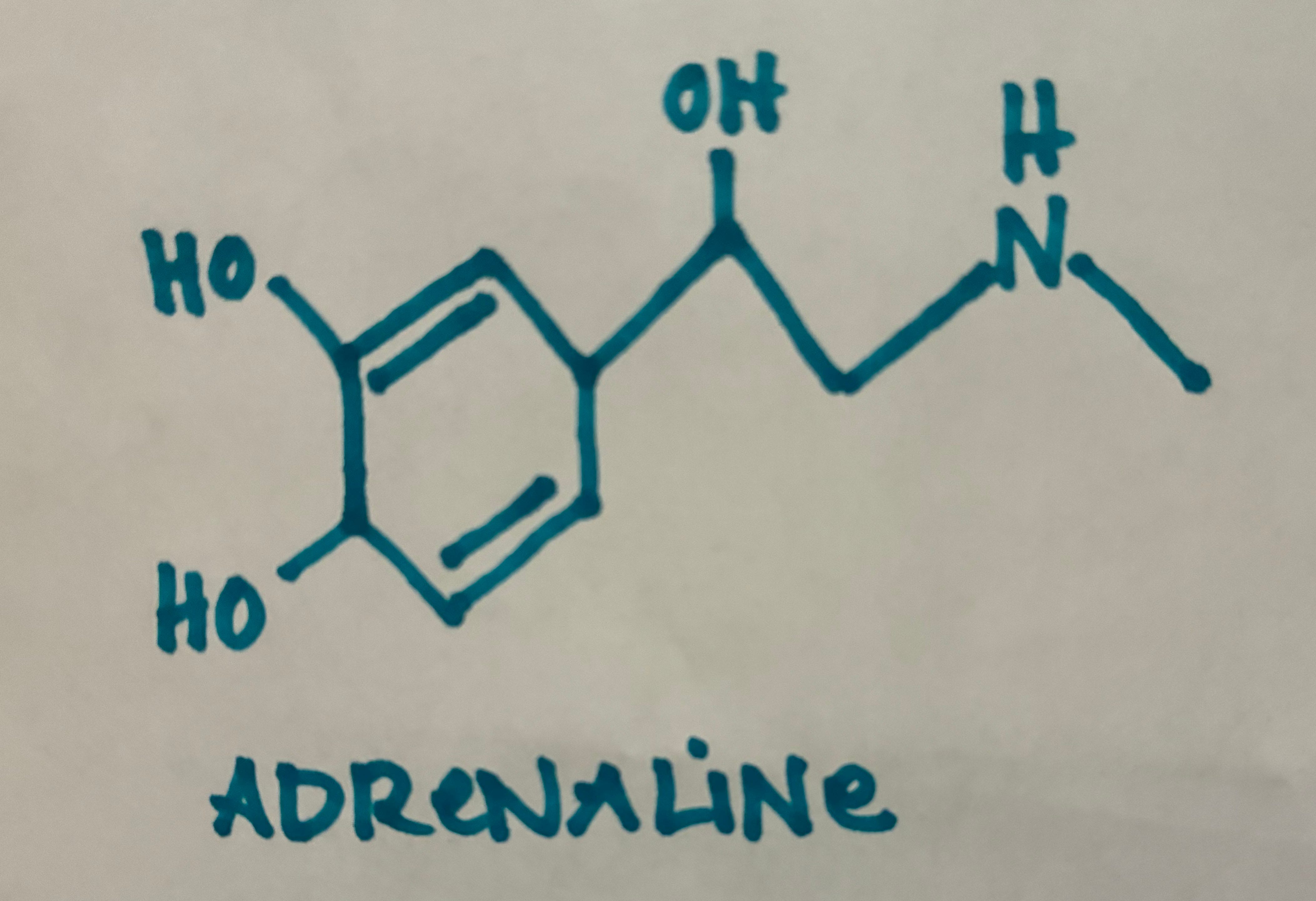
The images shows a teal-colored adrenaline molecule, with an IUPAC name of 1-hydroxy-2-(methylamino)ethyl]benzene-1,2-diol. The 6-carbon ring has 2 opposing double bonds and two adjacent OH groups on the left and a chain on the right containing an OH group and an NH group.
In July of 2018, I had a flurry of appointments. I saw a new PCP on the 5th. This article backtracks to July 2nd, when I had a stress test. An electrophysiologist (Dr. T), whom I’d seen after a cardiology visit at the end of June, ordered it.
Cardiac Stress Test
This test measures functional aerobic capacity (FAC) and predicts the likelihood of heart issues. It involves monitoring blood pressure (BP) and a continuous electrocardiogram (EKG) as the patient performs staged exercise (the physiologic stressor) on a stationary bicycle or treadmill. If the patient is unable to exercise, medication is used as the stressor.
When this test was ordered, I’d forgotten to mention running on a treadmill would be difficult because of my knee arthritis. Which may seem silly, but I hadn’t yet accepted the moniker of chronically illness, nor had I acknowledge having limitations to my previously healthy life. Oops.
After I checked in, a technician named Ethan led me through a labyrinth of hallways to a tiny, windowless room with a laptop and treadmill. He and a nurse (Michelle) would run the test.
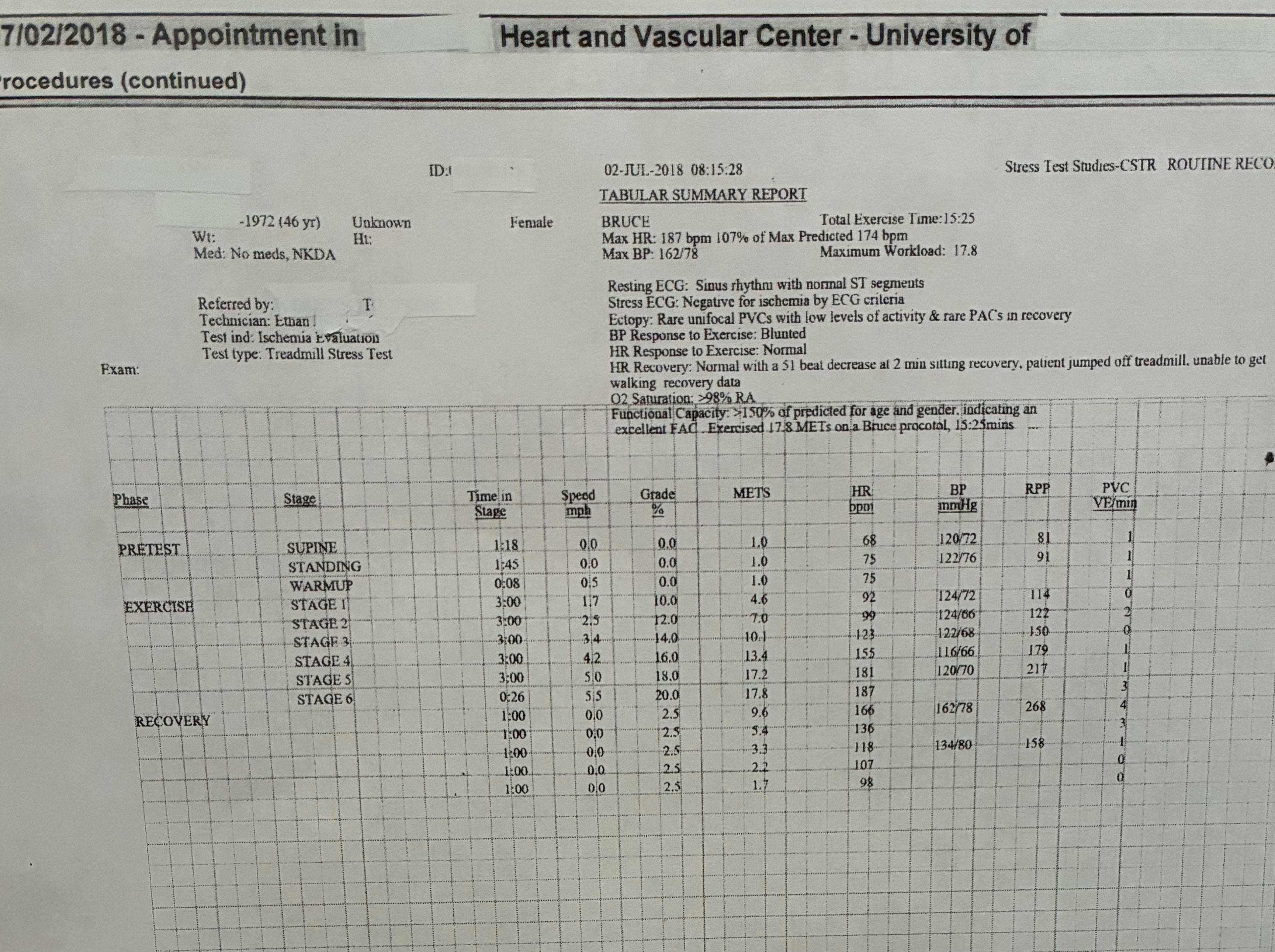
Michelle placed EKG stickers on my chest and Ethan took baseline manual BPs: 120/72 (while I was lying down) and 122/76 (standing). During the test, the speed and incline of the treadmill would be increased every 3 minutes. Ethan would take BPs at each stage and call out the values for Michelle to document on the computer.
The treadmill started rolling at a gentle pace.
“124/72” Ethan said.
Three minutes later, the treadmill groaned as the incline steepened and the pace quickened.
“124/66.”
“122/68.”
As the test continued, I relieved the stabbing pain in my knees by supporting much of my weight on the treadmill’s sturdy arm rails. Was this cheating?
I continued sweating on the treadmill. With my legs pumping faster and faster, body going nowhere, I must’ve looked like Wile E. Coyote.

The cartoon shows a blue roadrunner sticking his tongue out at a brown coyote who is chasing him with outstretched arms. Both the roadrunner’s and coyote’s legs are drawn in a circular way. Copyright Warner Bros. Entertainment. Picture found here.
“116/66.”
Exercise stresses the body, which typically causes BP to increase in a way that’s roughly commensurate with the workload. But my BP values were misbehaving, drifting downward like a soft, gauzy feather cutting half-arcs through the air. Until they suddenly plummeted like a feather dropped on the moon.
Ethan’s brow wrinkled, “I can’t hear anything. Write 120/70.”
My BP had become inaudible and I started feeling nauseous as the room spun. Familiar spots flashed before my eyes. I was about to pass out. Bad idea if you’re “running” (or whatever I was doing) at full tilt on a treadmill! I jumped off.
“Why did you stop?” Michelle demanded.
“I-I felt like I was going to pass out,” I panted.
My post-test BP rebounded to 162/78. My adrenaline had finally kicked in, too late to the party. After the last recovery BP (134/80), the test ended and Michelle left.
I suddenly started shaking violently. Adrenaline increases blood sugar uptake into muscles to prepare them for the jolt of energy needed to battle a vengeful ninja or run from a voracious saber-toothed tiger. This tardy and unruly adrenaline rush had likely dropped my blood sugar too low.
Ethan’s eyes widened.
“J-j-j-juice,” I sputtered.
He ran out and returned with juice. A few minutes after drinking it, I stopped shaking, but still felt weak. Wordlessly, Ethan walked me to the waiting area and I hobbled home on my tortured knees, feeling defeated and strangely dissociative. The stress test report wasn’t populated into my patient portal, so I had to submit a medical records request to read it, which I did last month.
How Were the Test Results Documented?
The fudged BP value was there, as expected. So was my jumping off the treadmill, but my threatening syncope and shaking/needing juice hadn’t been mentioned. The interpreting physician wrote that my BP response to exercise had been blunted.
More like collapsed.
The report also stated I had “excellent” FAC at 150% of predicted for my age, size and sex. This wasn’t a big surprise, because I was fit before my knees had swelled in March and when the pain made most cardio exercise too difficult, I’d switched my workouts to lifting weights and climbing overhanging walls. I also had undiagnosed dysautonomia, which shot up my HR with simple tasks, like showering and reaching up for cereal. It was like running a non-stop, daily marathon I hadn’t signed up for.
My maximum HR (187) was listed, but there was no mention that this value was abnormally high. Unfortunately, the events occurring during my cardiac stress test and the resulting report read like a case study in how not to run and document a cardiac stress test.
What Could the Healthcare Workers Have Done Differently?
Received better training to prioritize patient safety.
My BP had become unmeasurable during strenuous exercise – a flaming red flag that means the heart or nervous system isn’t working properly. This test should’ve been immediately terminated for obvious safety reasons, but Michelle and Ethan didn’t recognize the danger in having BP drop during exercise. Worse, at the time I was biking to get around in 95°F (35°C) weather.
Been curious/thought outside the box.
Nurses are taught to question everything. Why didn’t Michelle ask Ethan to confirm my BP was inaudible by immediately taking another measurement, instead of agreeing to document a fake “normal” response?
Documented abnormal responses.
I wasn’t asked about symptoms or syncope before the test. Would that have changed how my body’s response was perceived? Did Ethan report my shakiness to Michelle? There was a space to enter this info.
Reported abnormal findings to Dr. T promptly.
A quick call or portal message would’ve alerted her that something was very wrong with me.
Avoided tunnel vision.
I’d previously worn continuous EKG monitors twice, which showed abnormally high HRs. Some were associated with dysrhythmias, but most occurred with “normal” sinus rhythm. The stress test report’s false BP and glaring omissions, coupled with my “excellent” FAC results, tunneled the interpreting physician’s vision enough that he decided I was fine based on just one, contextless number.
What Could I Have Done Differently?
Ask Michelle and Ethan document accurately.
Why didn’t I confront them in real time? I couldn’t talk during/for several minutes after the test and I wasn’t thinking clearly, and Michelle had left. I also hadn’t found my voice yet to advocate for myself and sometimes, I still don’t speak out. Having to constantly self-advocate is exhausting and gets you labeled a “difficult” patient.
Ask Ethan to document my post-test condition.
I assumed he would do this without prompting.
Message Dr. T to tell her what had happened.
This also never crossed my mind. I went home and napped. More importantly, after ~3 months of fairly regular exposure to healthcare, I’d subliminally absorbed one of its core tenets: You can tell the truth, but it doesn’t matter because nobody believes you.
This stress test had been ordered to rule out structural cardiac issues, but had instead revealed severe dysautonomia. Because my abnormal results weren’t properly documented, it would be another month before anybody took my actual results seriously. The diagnostic odyssey continued …
I’m so sorry that happened to you. We all need to hear this story to give ourselves permission to jump off any real or figurative treadmills and stay safe. Then we need to follow up that we are documented properly. And you’re right self-advocacy is exhausting!
I got brave enough to write my story. Any chance you know you to animate x-rays 😃 so a surgeon can see my bone spurs sticking into my spine when I’m NOT lying flat in an MRI machine? 🤦♀️
I swear neurosurgeons are mentally deficient. I keep getting told “don’t use too many words, you’ll confuse the surgeon.” Should I pantomime? Do charades? JFC, I’m not their special ed teacher.
I’m back to lying down bc earlier today the physical therapist asked me to try some hip bridges—which pushed my body weight onto the bone spurs…. 🤦♀️
https://substack.com/@saracorlett/note/p-200946360?r=81i50f&utm_medium=ios&utm_source=notes-share-action